
How does inquiry-based learning support the unique academic and social-emotional needs of twice-exceptional (2e) students?
The Short Answer:
Inquiry-based learning meets 2e students where they are, fueling curiosity and deep thinking while providing the student-driven structure they need. Research in gifted education confirms that inquiry-based approaches, when paired with advanced content and structured guidance, produce stronger learning outcomes, deeper conceptual understanding, and greater engagement (Eysink et al., 2015; Can & Inel Ekicic, 2024). For 2e learners, this balance of challenge and structure is especially powerful.
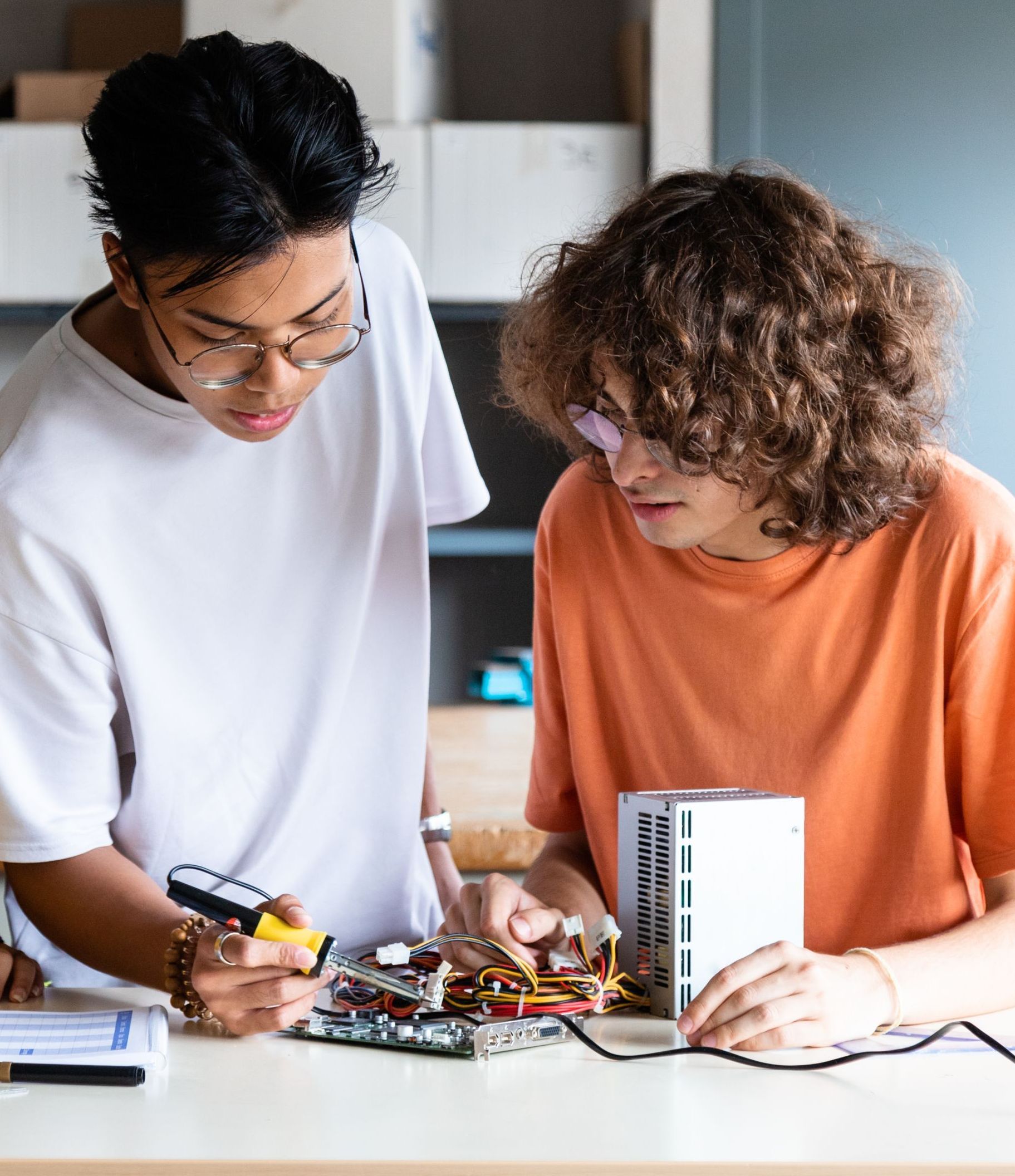
Inquiry-based learning is an instructional approach that emphasizes active, student-centered learning. Students ask meaningful questions, investigate real-world problems, analyze evidence, and construct understanding rather than simply memorizing information.
Research on gifted curriculum models identifies inquiry as a central best-practice instructional strategy for promoting advanced thinking and deep disciplinary understanding in gifted and 2e learners (VanTassel-Baska & Brown, 2007)[1.1]. Many 2e students enter school with intense curiosity, original ideas, and deep areas of interest. Yet, traditional classrooms often reward speed, compliance over complexity, and breadth over deep exploration. This mismatch can lead to frustration, disengagement, or underachievement.
This approach is particularly well-suited to 2e students, who are curious, analytical, and drawn to complex, open-ended tasks. When they investigate authentic problems, test ideas, collaborate, and reflect, they engage in the kind of advanced, concept-driven thinking that research shows benefits them most.
One form of inquiry-based learning is problem-based learning (PBL). This model uses real-life scenarios to foster deep thinking and application of skills to authentic contexts. A study of gifted fourth graders found that after eight weeks of PBL science modules, students showed significant growth in conceptual understanding and reflective thinking (Can & Inel Ekici, 2024).
That said, 2e learners benefit from scaffolded inquiry, not completely open-ended independent tasks. Guided prompts can be used to provide sufficient structure to make open-ended tasks feel manageable without limiting complexity or challenge. This strength-based approach allows students to access the depth and rigor that inquiry offers while still receiving the support they need to succeed.
“At Sage, we believe that every student has a powerful question inside them waiting to be asked. Inquiry-based learning gives our 2e students the opportunity to lead with their strengths—their creativity, their intensity, their deep thinking—while building the skills and confidence they need to navigate a complex world. When students are the authors of their own learning, they don’t just acquire knowledge; they discover who they are as thinkers.”
— Mandi Skerbetz, EdD
Co-Founder | CAO | Head of School
References
- Can, I., & Inel Ekici, D. (2024). Science learning through problems in gifted and talented education: Reflection and conceptual learning. Educational Studies, 50(5), 616–639. https://doi.org/10.1080/03055698.2021.1987860
- Eysink, T. H. S., Gersen, L., & Gijlers, H. (2015). Inquiry learning for gifted children. High Ability Studies, 26(1), 63–74. https://doi.org/10.1080/13598139.2015.1038379
- VanTassel-Baska, J., & Brown, E. F. (2007). Toward best practice: An analysis of the efficacy of curriculum models in gifted education: An analysis of the efficacy of curriculum models in gifted education. Gifted Child Quarterly, 51(4), 342-358. https://doi.org/10.1177/0016986207306323
Resources for Further Exploration
- Book: Inquiry Learning in the Gifted Classroom: It’s a Problem-Based World (2023) by Todd Stanley. Routledge: https://www.routledge.com/Inquiry-Learning-in-the-Gifted-Classroom-Its-a-Problem-Based-World/Stanley/p/book/9781032299013
- Website: Mensa for Kids (https://www.mensaforkids.org/) – Activities, lesson plans, and other resources for families of gifted and 2e children.
- Podcast: The Neurodiversity Podcast by Emily Kircher-Morris (neurodiversiypodcast.com) – 300+ free episodes on 2e, AHD< autism, and school advocacy.